








Impact of Electricity Act of 2023 on renewable energy investments for businesses
How the Electricity Act of 2023 (which followed the constitutional amendment) specifically affects solar or renewable energy investments for businesses
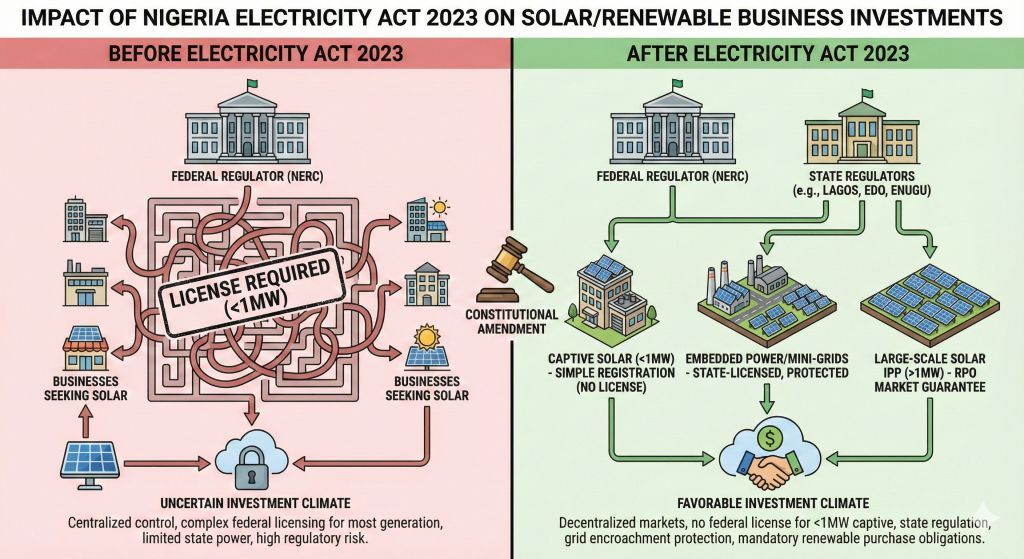
The Electricity Act of 2023 represents the most significant overhaul of the Nigerian power sector in nearly two decades. Following the Fifth Alteration (No. 33) to the Constitution—which removed electricity generation, transmission, and distribution from the Exclusive Legislative List—the 2023 Act effectively operationalizes the power of States to create their own electricity markets.
For businesses looking to invest in solar or renewable energy (whether for their own operations or as Independent Power Producers), the Act fundamentally changes the “ease of doing business” in four specific ways:
1. Liberalization of Licensing (The “1MW Rule”)
This is the most immediate benefit for Small and Medium Enterprises (SMEs) and commercial facilities.
The Change: Previously, generating electricity required a rigorous licensing process with the Nigerian Electricity Regulatory Commission (NERC).
The Impact: The Act exempts captive power generation (generating power for your own consumption) from requiring a license if the capacity is below 1 Megawatt (1MW).
For Businesses: If you are a factory, hotel, or office complex installing a solar hybrid system under 1MW (which is a substantial size—enough to power a large shopping mall), you no longer need a federal license. You simply need to register the plant. This drastically reduces compliance costs and project lead times.
2. State-Level Autonomy (Decentralized Markets)
The Act breaks the federal monopoly on power regulation. States can now issue licenses for generation, transmission, and distribution within their boundaries.
The Change: Once a State establishes its own electricity market (as Lagos, Edo, and Enugu have started doing), NERC transfers regulatory authority to the State regulator.
The Impact: Businesses no longer have to wait for Abuja for approvals on projects entirely within one state.
For Businesses: This allows for “Embedded Power” projects where a business can generate power and sell it directly to a neighbor or an industrial cluster without using the national grid, subject only to state regulation. This opens up new revenue streams for businesses with excess roof space for solar panels.
Once a State establishes its own electricity market (as Lagos, Edo, and Enugu have started doing), NERC transfers regulatory authority to the State regulator.
3. Protection for Mini-Grid & Off-Grid Investors
The Act provides stronger legal protection for businesses investing in mini-grids (independent grids serving a specific area/community).
The Change: It codifies the protection against “Grid Encroachment.”
The Impact: Previously, if a solar mini-grid investor electrified a rural commercial hub, they risked losing their investment if the local Distribution Company (DisCo) later extended the main grid to that area.
For Businesses: The Act mandates that if the DisCo extends the grid to your area, they must either compensate you for your asset (the solar plant/poles) or allow you to operate as an interconnected mini-grid. This significantly “de-risks” long-term solar investments.
4. Mandatory Renewable Purchase Obligations (RPO)
The Act introduces a market for renewable energy certificates and mandates consumption quotas.
The Change: It mandates that electricity generation licensees and DisCos must purchase a specific portion of their energy from renewable sources.
The Impact: This creates a guaranteed market for Renewable Energy Independent Power Producers (IPPs).
For Businesses: If you are a large business investing in a large-scale solar farm (>1MW), the law now compels the grid operators to buy a portion of your green energy, arguably creating a more stable demand profile for your investment.
Practical Next Step
If you are considering a solar transition for your business, the first step is to determine your Peak Load.
If <1MW: You can proceed immediately with procurement and installation; you generally only need to register the system with your local DisCo/State regulator for safety compliance.
If >1MW: You will still need a permit, but you should now check if your State (e.g., Lagos or Edo) has established its own Electricity Commission, as you may be able to apply locally rather than through NERC.