








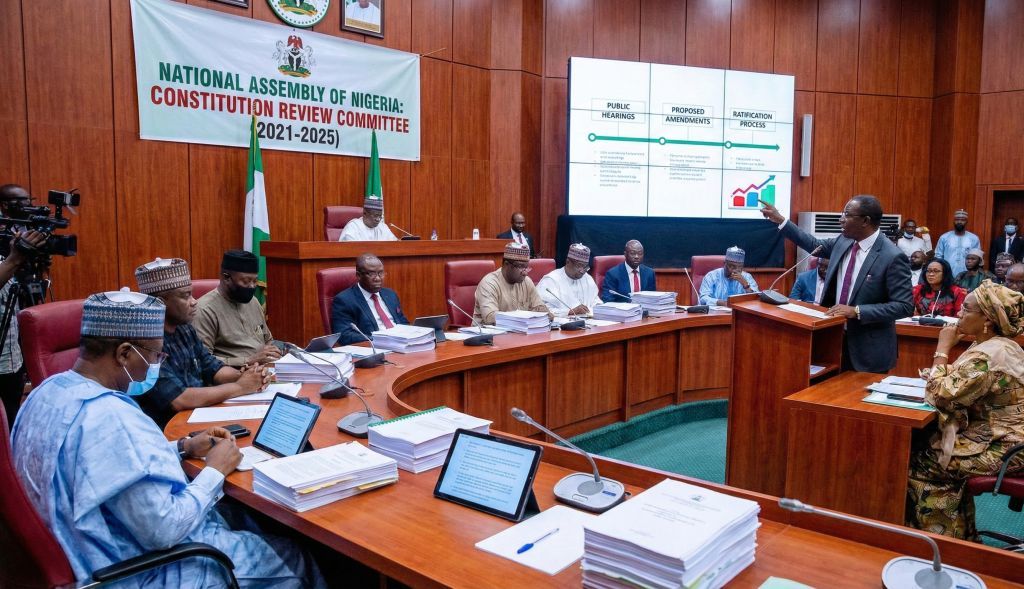
Nigeria constitution review in recent years
Recent years have seen a significant shift in Nigeria’s constitutional landscape, primarily driven by the Fifth Alteration (completed in 2023) and the currently ongoing review by the 10th National Assembly (2024–2025).
The most impactful changes have focused on devolution of powers—moving exclusive federal responsibilities to the states to encourage fiscal federalism.
1. The Fifth Alteration (Signed March 2023)
Just before leaving office, former President Muhammadu Buhari signed 16 constitutional amendment bills into law. These are widely considered the most economically significant amendments since 1999 because they broke federal monopolies in key sectors.
Key Amendments Now in Force:
⚡ Electricity (De-monopolization):
Old Law: Only the Federal Government could legislate on electricity generation and transmission.
New Law: States are now empowered to generate, transmit, and distribute electricity—even in areas covered by the national grid.
Impact: This allows states like Lagos, Edo, and Abia to create their own electricity markets and license private investors independent of the federal TCN (Transmission Company of Nigeria).
🚆 Railways:
Old Law: Railways were on the Exclusive Legislative List (Federal Govt only).
New Law: Moved to the Concurrent List.
Impact: States can now build, own, and operate railway tracks and services. This enables regional rail projects (e.g., a train connecting Lagos to Ibadan run by the states rather than the federal NRC).
🔒 Prisons (Correctional Services):
Change: “Prisons” was removed from the Exclusive List and re-designated as “Correctional Services” on the Concurrent List.
Impact: States can now establish and manage their own correctional centers, which is intended to decongest federal prisons.
⚖️ Financial Autonomy:
Change: Granted financial independence to State Houses of Assembly and State Judiciaries.
Impact: These bodies now receive their funding directly, reducing their dependence on State Governors and theoretically improving checks and balances.
.
It’s worthy of note that for any of these current proposals to become law, they must be passed by 2/3 of the National Assembly and then approved by 24 out of 36 State Houses of Assembly.
M&S
2. Current Review: 10th National Assembly (2024–2025)
The 10th National Assembly (inaugurated in 2023) has started a new round of reviews with a deadline to conclude by December 2025. The committee is chaired by Deputy Speaker Benjamin Kalu.
Top Agenda Items:
Issue, Status & Goal
- State Police High Priority: A bill to establish State Police passed the second reading in the House of Reps in early 2024. This is a response to rising
insecurity that the centralized federal police cannot handle alone. - Gender Bills Revisiting: Bills that failed in the 9th Assembly (like “Special Seats for Women” and “Citizenship for Foreign Husbands”) are being
reintroduced with fresh lobbying. - LG Autonomy Focus: Strengthening the financial and administrative independence of Local Governments to prevent Governors from seizing their funds.
- Traditional Rulers Proposed: A proposal to give constitutional recognition and defined roles to traditional rulers to help with local security and
intelligence.
Why This Matters to You
Business Opportunities: If you are in the private sector, the 2023 amendments opened up massive investment opportunities in power (mini-grids, state utility companies) and transport (state rail lines) that were previously illegal.
Security: The ongoing debate on State Police in 2024/2025 could fundamentally change how security is managed in your community, potentially making policing more localized but also raising concerns about political abuse by Governors.